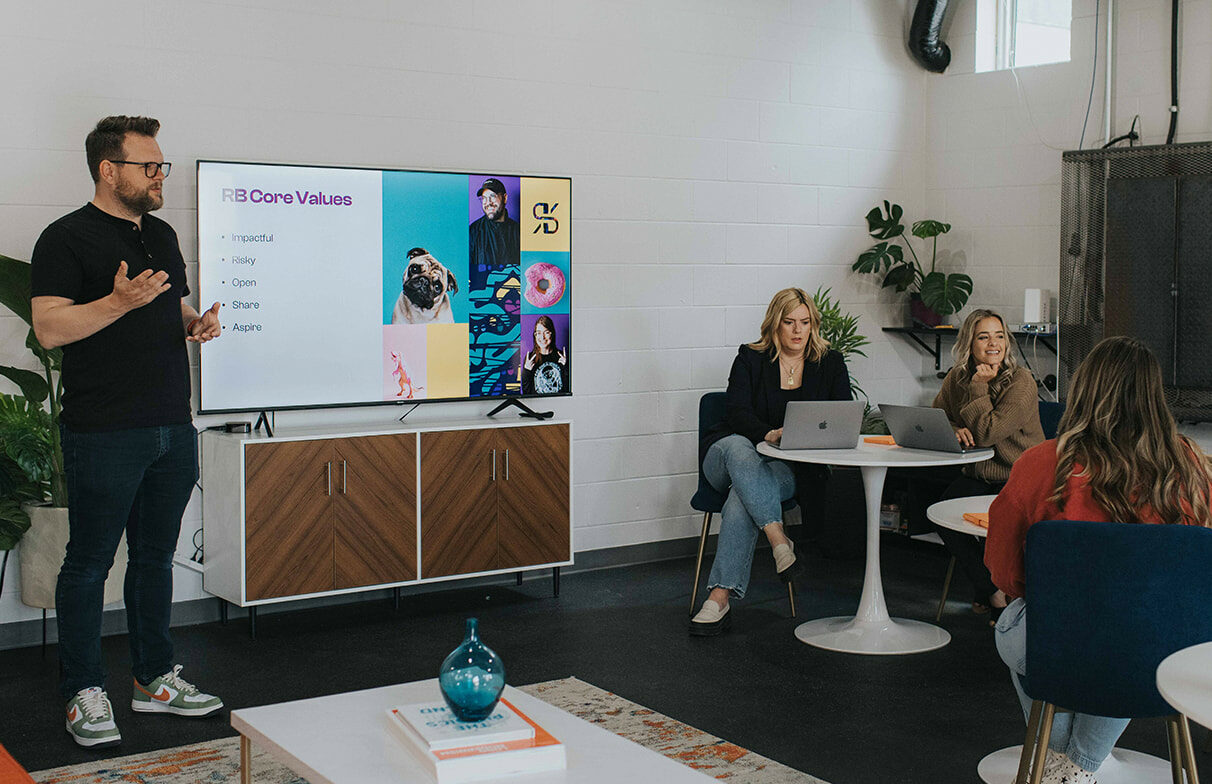
I’ve been working at Rock & Bloom for nearly a year now, and I still vividly remember my first week, when I learned of “pouts & tendies.” (For the record, that’s ‘pouts’ like ‘poots’, not ‘pouts’ like ‘sad face’).
We were all in the office together playing some Jackbox games and ‘pouts & tendies’ was dropped multiple times. Now, I consider myself as close to “down with the kids” as a 30-something woman can get. While I might not TikTok, I think Twitter keeps me up to date with most of the goings-on in the world, and yet, I still didn’t know what pouts & tendies were. Being the new person, I found the courage in myself to ask, what exactly is pouts & tendies? And the answer was simple. Poutine & chicken tenders – a beloved dish at Rock & Bloom (that is best eaten at Park Cafe, but be warned you might need asiesta after a lunch that heavy). This was my first exposure to what I can only describe as the “food wars” culture within our team.
We are a group of very passionate individuals.
Whether it be related to our specific roles or our clients, we get down to business. And the same can be said about our opinions on food. I can’t count the number of times that I’ve been in a meeting and come out to see the #random Slack channel on fire. 80+ messages. The panic sets in. What did I miss? And then once I’ve scrolled back far enough, I realize that someone mentioned that they had the best shawarma of their life over the weekend. Calamity ensues. And by the end of it, I have a list of new restaurants and dishes I need to try.
So you may be asking, what’s your point?
Rock & Bloom loves food and can argue about it – a lot – big deal? I for one cherish these moments. In the year that I’ve been working here, we’ve still largely been working remotely (thanks, Covid) and yet, not a moment has passed where I haven’t felt like part of the team or connected to my colleagues. While these food discussions might seem mundane, they are a huge part of what makes Rock & Bloom such an amazing place to work. Sometimes those Slack discussions can sidetrack your day by 15 or 20 minutes, but they’re such a joy when they happen because of the connectedness it fosters. It makes working remotely seem far less remote.
From our Instagram brackets about the worst Christmas chocolate to our heated discussions about rotisserie chicken on homemade pizza, Rock & Bloom at its core is a group of unique individuals who are filled to the brim with passion.
I saw a headline on Twitter that was to the effect of, “Is having fun at work really a good idea?”
It made me laugh because I don’t know when the disconnect happened. How having fun at work could possibly be a bad thing? There are certainly companies out there who think good office culture is having beers on Fridays and a ping pong table in the office, and I can tell you from experience that that is not enough. Our food opinions might be quirky, but it encompasses the culture that we try to foster.
At my last role, I had bought into the mindset of climbing the corporate ladder – and I wanted to be on top. But over time, I realized that my goals and values had shifted and that they no longer aligned with where I was working. I came to terms with the fact that I was really good at my job, but I didn’t really enjoy it. When I interviewed at Rock & Bloom, we got talking about the future and I was asked where I saw myself in five years. I said, “Had you asked me last year, I would have said partner at an agency. But I realize now that where I want to be is doing kick-ass work with kick-ass people. That’s it.” And here I am, not even a year later, and that is exactly what I’m doing.
The team at Rock & Bloom is small but mighty.
We bring the same level of passion to ‘pouts & tendies’ as we do to our client work. Rock & Bloom puts people first, and when you do that the result is magical – and I consider myself so lucky to be a part of that magic.
Like the first tiny, green buds on our trees after a long and frigid winter, the City of Saskatoon truly comes alive during the summer months – and it’s beautiful.
The community is bustling, the patios are in full swing, and the ice cream dripping down the side of your hand is oh so sweet.
Come along as we wander through the classic summer must-dos, the new experiences, the better-with-friends outings, and the make-you-feel-like-a-kid-again activities.
Here’s your Saskatoon Summer Bucket List: 2022 Edition.
Saskatchewan Jazz Festival
This year marks the 35th anniversary of the adored summertime festival. What better way to kick off the summer than with eight straight days of music and fun. Check out the schedule and snag your tickets early!
Picnic in the park
Nothing is cuter than a picnic in the park – and Saskatoon’s got 200 of ’em to choose from. Grab your checkered blanket and head to Boffins Gardens at Innovation Place. A picturesque setting, home to a large pond and plenty of flowers.
Prefer something a little fancier? Try out Boho Picnic YXE for an unforgettable picnic experience. These instagram-worthy setups are perfect for a special occasion or surprise party.
Make a summer playlist
Your summertime antics would not be complete without an upbeat playlist to serve as your soundtrack. Take some time to curate the perfect sound yourself, or start a collaborative playlist with your work colleagues or best friends. Everyone chooses 5 songs that remind them of summer – a fun way to get some new tunes.
Go on a coffee crawl
This has been on my list for a long time, but this is the year I’m finally making it happen. Organize a coffee crawl, by yourself or with friends, and experience all of the amazing local cafes that make our city special. Choose a handful of cafes you’d like to try – old favourites, classic hangs, and exciting new spots – and visit them all! Map out your route starting at one end of the city and making your way across, stopping at all of your chosen spots. This is your opportunity to try as many different menu items as possible, or get the same thing at every place and compare the quality.
Go camping
We’re lucky to be surrounded by a plethora of lakes and campsites. Pick your favourite and spend a weekend under the stars. Tenting is my preferred choice of camping, but if you don’t like roughing it, a cabin can still provide that rustic outdoor experience – with running water.
Don’t want to go too far? Camping still counts even if it’s in your own backyard.
Relax with a lazy river float
Take advantage of our beautiful South Saskatchewan River with a lazy river float. Drifting down the river while soaking up the sunshine is the perfect way to relax and recharge. If you’re more of an adventurer at heart, try paddle boarding or kayaking.
Volunteer your time
Research volunteer opportunities in your area. Choose something that aligns with your values and that you would find soul-filling. For example, if you love animals the Saskatoon Dog Rescue is always looking for more volunteers. And what better way to spend your time than helping our furry friends find their forever home.
Not an animal person? No problem. Humans need our support too. Try volunteering at Ronald McDonald House Saskatchewan and help families that need it most.
Ditch the city for a Manitou Beach/Watrous day trip
If you’re looking for a quick weekend getaway, this is the perfect choice. Manitou Beach is only a short hour and a half drive away, but feels like another world. Swim in the healing mineral lake, visit the quirky vintage shops, stroll through the Little Manitou Art Gallery (and if you’re lucky catch a musical performance by a local artist), stop by the Video Stop – Watrous’ infamous movie rental store (it’s like if Blockbuster still existed, but way better), and finally, finish off the trip with a movie at the drive-in. Popcorn mandatory.
Take your pup swimming
Every year at the end of the summer, before they drain the water, Mayfair Pool hosts a year-end dog swim. It’s exactly what it sounds like and so much more. Watch all the dogs jumping in the water excitedly and having the time of their lives (except my dog, who ran away immediately and spent the entire time on the grass as far away from the pool as possible). Your dog will love it (or hate it) but either way it’s worth it for the chance to see a corgi in a lifejacket.
Go on a roadside attraction tour
Saskatchewan is home to many roadside attractions (world’s largest paper clip anyone?!). Grab a coffee, get the tunes ready, and take a roadtrip to nowhere. As you drive, stop by any roadside attraction you come across and snap a pic for your memories. If you’re really into roadside attractions like I am, you can pick up “Larger Than Life”, a guide to Saskatchewan’s big roadside monuments. My personal fave is the angry combine near Biggar.
Try something new
Maybe some things on this list intimidate you. Or make you feel anxious. Or are things you would never think about doing in this lifetime. But summer is a time of new possibilities. So try something you haven’t done before. The best things happen when we step outside of our comfort zone.
Check out the full bucket list below and download it for yourself!
Trying out a new, delicious recipe. Snacking on Purdy’s chocolate hedgehogs while getting lost in an audio book. Applying henna and allowing your hands to be free to absorb the natural dye. Tackling an outdoor DIY project. Participating in an all-day gaming marathon. Working out and indulging in an at-home manicure. Exploring the hidden gems in your city. Spending quality time with loved ones. Snuggling your partner, your kids, your dog.
For most of us, a Friday morning looks nothing like this. But for the team at Rock & Bloom, where every second Friday is Recharge Day, this is our reality.
Rock & Bloom welcomes Recharge Day
Recharge Day, you ask? Never heard of it. Neither had I until our dynamite duo (aka the people who run the biz) introduced it as part of our company’s core values. It goes something like this…
Every second Friday our office is closed so that our team can rest, relax, and recharge. It’s an extra day a month to say sayonara to responsibility, and do something soul-filling that’s good for our mental health.
The purpose of implementing Recharge Days is to promote work-life balance and put our company values into practice. We know that we do better work when we are refueled & recharged.
The proof is in the pudding
With burnout rates at an all-time high, the concept of a recharge day feels refreshing and proactive. COVID-19 has changed the landscape in which businesses operate and it’s clear that employee well-being is becoming top priority for many organizations.
While support for recharge days, mental health time, or the four-day work week gains momentum, there is still opposition to overcome. Some believe that working less hours equals getting less work done and, in turn, bringing in less profit. However, the evidence says otherwise.
A Microsoft subsidiary in Japan trialed a 4-day workweek in 2019 and reported that productivity increased by nearly 40 per cent compared to the year prior. A New Zealand firm, Perpetual Guardian, found that employees’ time spent on non-work websites decreased by 35 per cent when working hours were cut by 20 per cent.
That’s not all. According to Forbes, from a financial perspective, research indicates that moving to a four-day workweek can reduce overhead and other costs to businesses. Employees not only take fewer sick days but are generally more productive.
What recharging looks like
Recharge Days offer our team time to spend alone, run errands, get caught up on housework, rest, have fun, or do something that sparks creativity. Our team has been loving the extra days off and making the most of it. Take a look at some of our Recharge Day highlights!
“Recharge Day means an actual commitment to mental health. It feels so good to not only have your employer believe in you as an employee, but fully care about your well-being. It’s a freeing and empowering feeling.” – Matt Horning, UX Strategist & Developer
“I often find that I make everyone else’s care, except my own, a priority. Recharge day is a day just for me. It’s a day where I can reflect on myself and my needs. By taking care of myself I know I’ll be a better co-worker, friend, and mom. Recharge day helps keep me accountable to refilling my tank. It’s magical. – Valerie Baier, Senior Designer
“An ability to slow down and push pause on life. I love that we have created an environment where we can all focus on what’s important to us. What fills our cup. A no guilt, no pressure day just for me.” – Heather, Co-Founder & CEO
“Recharge Day for me is a bonus day where I get to decide what I want to do. Oftentimes, as a parent, my weekends are filled with kid and family things and I often don’t get to recharge myself. It’s nice to save up my appointments for that day so I’m not stressed having to fit them in during the week/weekends or if I’m really burnt out it’s a time for me to do absolutely nothing without feeling like I should be doing something.” – Molly Lux, Account Manager
“It speaks to the culture and values that permeate throughout everything that is Rock & Bloom. It’s a day to recharge, spend outdoors, with family or friends, accomplishing day–to-day tasks, appointments, etc. It means being more efficient with time and feeling like you are not counting seconds or minutes in the work day.” – Larissa Katsiris, Sales & Marketing Strategist
“Recharge Day is the day I get to recharge my batteries, put aside work and life distractions, and focus on what makes me happy. It’s the day where I can sleep in – guilt-free – and wake up without an alarm clock. It’s the day that reconnects me with myself, my family, and my friends. It’s a day dedicated to doing what I love, not to things that don’t matter.” – Jill Leclerc, Designer
“Recharge Day for me has been a day of slow reflection and a day of gratitude. When it was announced in our monthly share session it made me feel seen and heard. I felt like I worked for a company where it wasn’t just the bottom line that mattered. I, we, as employees, mattered. Our mental, physical and emotional health mattered.” – Mona, Project Coordinator
Creating your own Recharge Day
Interested in implementing your own Recharge Day? Here are a couple of things to consider.
1. Communicate
With your team, your clients, your customers, your followers and fans. Get the word out loud and clear about what you’re doing and why you’re doing it. Transparency is key to making a big change and will help to ensure the transition is successful.
2. Be Flexible
Connect and check in with your team to get feedback about what’s working and what’s not. The goal is for employees to feel less stressed, so if there is friction it should be identified and addressed right away. Be prepared to shift and pivot as needed to create what works for your team.
3. Work together
This is an opportunity to work together as a team to be as efficient as possible. Remember that you’re not alone. Lean on your team mates, ask for what you need, communicate your concerns, and most importantly, share in each other’s joy as you work to become stronger and more collaborative.
It is said that the greatest asset of any company is its people. So take care of your people, let them recharge, and watch what happens when that goodness trickles back into the work that they do.
Sought-after Saskatchewan brand studio, Rock & Bloom, is launching their first-ever, fully-funded ‘Ultimate Brand Course and Workshop’
For immediate release. June 6, 2022, Saskatoon, SK,
Rock & Bloom has made a career out of building relationships and creating killer brands for hundreds of clients across North America, from agricultural giants to local small businesses, and everything in between. Now, they’re turning to local business owners, non-profit directors, and senior level decision makers to offer an immersive, in-person, and fully-funded ‘Ultimate Brand Course and Workshop’.
“Your brand is the backbone for business decisions,” says Heather Adams, Co-Founder and CEO. “The companies that know their brand and can communicate it well through every facet of their business are going to be the most successful.”
Facilitated by founders Heather Adams & David Molesky, the decision to offer workshops presents an opportunity to connect with and help businesses that haven’t had the chance to work with Rock & Bloom in the past.
“We want to help businesses, and we hate having to say no,” says Adams. “So when someone comes to us and they’re really excited to work with us, but for some reason it doesn’t align – whether it’s because of budget or timing or a number of other things – it’s really hard. We see this as an opportunity to help these businesses lay the foundation for their brand strategy to truly level up for the future.”
All too often, business owners and entrepreneurs are working in their business, as opposed to working on their business. This course will allow them to focus on their own business’ needs by following a curriculum-based approach that leaves plenty of room to actually apply the fundamentals. Business owners will be able to leverage brand experts to challenge them by asking tough questions and helping them see their brand through a different lens.
“The foundation of Rock & Bloom and why we exist is not just to make pretty things, like beautiful designs or nice websites; it’s to actually help affect change in a client’s business. if we can affect change and help them reach that next level, distribute to a new market, launch a new product – that’s what gets us out of bed in the morning.”
Rock & Bloom is a top-tier brand design studio that leaves a lasting impact on your growing business. We take an authentic and honest approach to every project we touch. We create killer brands that shape perceptions, build an audience and drive sales.
When you visit a website or look at a brand, what is the first thing you notice?
Is it the colours? The logo? The icons and animations? Maybe it’s the font or the layout of the page? Whatever your answer, it likely has something to do with the work of a designer.
Design is, without a doubt, one of the most crucial parts of creating a brand. Did you know that it only takes 0.05 seconds for a person to form an opinion about your website? First impressions are truly make or break. Luckily, good design can set you up for long-term success.
Good design builds recognition, credibility, and trust. It forms lasting connections and tells a brand’s story in a compelling and authentic way. How do you guarantee good design? Well, it starts with hiring the right designers.
Jill Leclerc makes up one-third of Rock & Bloom’s superhuman design team. She eats veggies like they’re candy and is a master of gardening, which is probably why she can take an itty bitty seed of an idea and grow it into a beautiful and functional brand, all while making it look easy.
Here are some of Jill Leclerc’s top design tips:
1. Collaborate
Everyday at Rock & Bloom the design team takes part in a design standup, where they share what they’re currently working on. Leclerc says the daily standup is a beneficial way to naturally get feedback from other designers.
“We’re constantly sending each other our design work and getting each other’s opinions and suggestions,” says Leclerc. “We’ve been collaborating a lot more and it’s really impacted our work in a positive way.”
Leclerc notes that this is also where she finds her inspiration – speaking with other designers and creatives.
“I often ask ‘How would you approach this?’ or ‘What style would you go with?’ or ‘Do you think that this is too modern or too old school?’ I think the more eyes, and the more you can collaborate on a project, creates the best result.”
2. Research, research, research
“Honestly, I do a ton of research,” shares Leclerc of her personal process. “I find if I do a lot of research myself, that inspiration comes naturally because I have a really good grasp of the concept. I can just start iterating, and then not stop – it just keeps snowballing.”
One of Leclerc’s goals is to expand her research even further, and to find ways to be more inclusive in her designs.
“We do cool websites for all kinds of people and when it comes to people who are less represented than they should be, as a designer you want to make sure that they’re being represented in the right way. In the way that they want to be.”
3. Get out of your comfort zone
Leclerc says that the most challenging part of her job is doing things that are out of her comfort zone. They are also (usually) the most rewarding.
“I wasn’t trained in school for web design, so doing a website for the first time, when you’re less comfortable with the program and web design rules, is definitely the most challenging because you don’t know what you don’t know, and you don’t know what you’re supposed to know,” says Leclerc. “It kind of humbles you. You have to be okay with making mistakes and understanding that it’s okay not to be the best because you’re new to this. Does it mean you suck? No, It just means you’ve got to learn and make mistakes, and then you won’t make them the next time.”
4. Perfect is the enemy of good
One of my favourite quotes of all time goes something like this: “A work of art is never finished. It is merely abandoned.” This applies to creative works of all kinds. Striving for perfection is pointless, because even if you’re happy with the end result, you might look back at it a month later and hate everything about it. Such is the curse of the creative.
Leclerc notes that at some point she has to know when to walk away from a design, because it will never truly feel like it’s done.
5. Be open-minded
“This is the one I reiterate all the time, but the best thing I learned in school is to be open-minded,” says Leclerc. “Don’t stay attached to your designs because you’re not designing for yourself. So stay open-minded, show your work to other people, get their feedback, and really absorb what they’re saying.” In other words, being adaptable and flexible as a designer leads to the best outcomes.
6. Mind the Dos and Don’ts
Not all websites are created equal. Here’s a quick breakdown of Leclerc’s website design dos and don’ts.
Do:
Be consistent
Create a user-path that involves the least amount of clicks
Make important information easily accessible
Keep pages scannable
Use high-quality, original photography where possible
Have fun with it! Hidden Easter eggs and quirky 404 pages are simple things that can really elevate a website
Don’t:
Mix too many fonts
Have low contrast text
Settle for default illustrator colours
Use a really stark colour palette
Use different stroke weights on graphics incidentally
Try to do everything. Make design choices intentionally.
Design work involves a lot of things that the average person might not think to look for when they visit a website, but the overall experience matters greatly.
“People can go to a website and say, ‘Oh, that looks bad,’ but might not be able to pinpoint why it’s bad,” says Leclerc. “And usually it’s a combination of fonts or weights or brushstrokes or colors. There’s all of these different things that go into creating a good design that the average person isn’t thinking about, but would notice if it were off.”
Looking ahead
Brands are constantly growing, and since the onset of COVID-19, they’ve had to adapt at a quicker rate than usual.
“People can’t get away with not having a website anymore or not having a social media presence,” says Leclerc. “And some people had a really hard time before COVID, understanding how important that was. Anyone who was a little bit skeptical regarding the effectiveness of a website, now believes in having an online presence.”
Moving forward Leclerc thinks that brands will try to humanize themselves more and focus on building stronger relationships with customers.
“It seems like designs are becoming more human, less corporate. I find more brands want to connect with people in a personal way rather than a corporate way. The world is becoming less suits to work, more pajama pants while working from home at your computer.”
As for Leclerc, she’s very content in her pajama pants, but much like the gardener she is, also excited to grow. “I’m only starting out in my career. And I know that, if in the future, my goals or my dreams change, Rock & Bloom is willing to adapt with me. They have the flexibility and want to see everyone grow. I know that it’s never going to be, “That’s not your lane. Stay there. Just stay small.’ It’s more like, ‘Where do you want to go and how can we help you get there?’”
A day in the life of a developer can look very different depending on the project.
Whether the day calls for back-end server work, transitioning clients onto a new hosting platform, fixing bugs, or CSS and JavaScript – developers need to remain flexible and adaptable.
“It’s like different languages,” explains Matt Horning, Developer at Rock & Bloom, as well as self-proclaimed R&B Tastemaker.
“You go from coding, where you’re literally speaking a different language in your head, to a creative meeting where you suddenly have to use the other side of your brain.”
It’s challenging work, but it’s the kind of stuff that gets Horning excited about his job.
“I like doing different things and I like being able to stretch or use different muscles. That’s why I prefer to work at a place like Rock & Bloom versus a different company where they focus on their own product. It is enjoyable to have different projects, and those projects require different things. It keeps you on your toes and it keeps you learning.”
Unfortunately, being flexible and adaptable can be a double-edged sword. Developers become so adaptable that they need to be good at managing their own time and their own mental state.
“It’s difficult to go from CSS and styling in the morning to a creative name jam, and then into fixing a bug on your server or into JavaScript in the afternoon. It’s really taxing – the context switching that your brain does, and it becomes a skill to manage that, because it’s so easy to burn out as a developer.”
Luckily Horning has a few things that keep his mental health and productivity in check.
Matt Horning’s 3-step guide to staying sane as a developer:
1. Focus
Try to give yourself as much focus as you can. Block off time and eliminate distractions. At Rock & Bloom we utilize Focus Time twice a week. Focus Time is a 2-hour window that team members block off in their calendars, and no one else can message you on Slack during that time. This allows you uninterrupted, productive work time.
2. Exercise your brain
If you know you have a creative day coming up or there’s tasks that will involve flexing your creative muscle, try to exercise that muscle early on. For Horning, that means listening to music or singing or trying to do something where he’s feeling rather than thinking.
3. Reset
Going from something super technical into something creative? Reset your mind. Something as simple as going for a walk is often enough to reset and help you transition to a different kind of task.
We’re incredibly lucky at Rock & Bloom to have the most diverse trio of developers. Developers who can tap into their right brain when needed, and their left brain when needed. Developers who can speak in code, but also in colours and textures.
“That is why we work here; because we have such an ability to make an impact on every different level,”
“You have such a separation of roles in some places where ‘devs are just devs’, and if it’s code, then they can do it, and if it’s not, then don’t ask them. Those people are fantastic at what they do and they have a great home at other companies, but it would never work here. We’re kind of a bunch of jack-of-all-trades, and we’re a really special group.”
With such a diverse skill set, it’s no surprise that Horning had trouble coming up with a favourite project. However, the first one that came to mind was Sask Jazz.
“It’s not a project that I’ve done a ton of work on,” says Horning, “but I think the creative landscape of that project and the ability we have to really make something that’s physical that people can actually experience is really cool.”
He describes the feeling of going to the festival, being a part of it, seeing your work on posters and lanyards and stage design. Being immersed in something you helped create.
“Those mean the most. Being able to see it; that’s a big part of my drive for a project. I want to do something, but I want something to happen because of it.”
” I don’t want to just put nothingness into the universe. I want there to be some sort of ripple back of enjoyment. I want to be able to create something and then see it and physically experience it.”
The highlight reel doesn’t stop there, though. Horning’s had success with other favourite projects such as creating loading animations for Remai Modern, and adding unique touches to Motif to help highlight their personality. At the end of the day, Horning’s goal is to create something that allows a person to experience something they haven’t before.
It’s this passion that really sets a developer apart from the rest. Horning often gets asked if he fears that Squarespace or Wix is going to steal his job. His answer?
“No. If you need a vehicle, you can go and buy a bicycle. You can buy a car for a thousand dollars that’s going to get you from point A to point B. Or you can go and buy a Mercedes. It’s also going to get you from point A to point B.”
“It doesn’t matter which you buy, it’s the experience that you have while you’re doing it. “
Similarly, if you want to make a website, you can go make a website. You can make a website today in 10 minutes and it’ll probably achieve a lot of the goals that you’re trying to accomplish. But at the same time, it’s not going to have the experience that we can create.”
Experience is crucial for a brand. Not just for your customers, but for your employees as well. Creating an environment where employees can thrive and be the best version of themselves takes a company from good to unstoppable.
Horning is grateful to have found what makes his feet jump out of bed in the morning and his heart feel full at the end of the day. His advice for other developers is to find what makes you tick.
There’s a large push to get jobs in tech because it’s a very safe path and an area of business that is only going to grow. However, as Horning notes, it’s so wide and variable that there is so much opportunity to get lost and to work for people who don’t value what you do or get pushed down a path you’re not going to enjoy.
“Developing is a tough job,” says Horning. “I hope there’s a moment where you’re able to just stop and say, ‘Why do I want to do this? What do I want to get across with this career?’ The money is always going to be there. But where do you make your impact?”
Are you a vegetarian? Or perhaps you’re just someone who wants to try cooking more vegetarian food?
Whatever your reason, this list outlines my top five Saskatoon staples that cater to vegetarians. Use it to inspire you the next time you’re looking to eat out or want to enjoy some delicious vegetarian options at home. Whether you live in Saskatoon or are simply passing through, I hope you find these tips useful.
Good Farmer Tofu
Tofu isn’t something that most people think about, but if you’re going to buy tofu from the grocery store, you should know that you’re probably getting a less-than-fresh product that tastes like cardboard. Good Farmer Tofu has some of the freshest and most delicious tofu you’ll find anywhere in Saskatoon. They sell traditional Chinese-style tofu and their soybeans are always fresh, which is what gives it its amazing flavour. You can enjoy their tofu on its own or use it in any recipe that calls for it! I’ve visited this place a few times to stock up my freezer. Visit the recently opened location in Stonebridge to try their fresh products and meet their friendly staff members.
Bulk Basket
Located directly across the street from the Rock & Bloom headquarters, I love shopping at Bulk Basket. I am always finding things there that I have a hard time finding anywhere else, which is why it is such a staple for me. Bulk Basket sells tons of products in – you guessed it – bulk, which means you can grab as little or as much as you need. They have a wide variety of items such as loose leaf teas, unique spices, uncommon flours, and so many kinds of dried beans. My favourite thing to pick up would be the Depuy French green lentils, which have a nutty and peppery flavor. You can use them in so many vegetarian recipes to add flavour and texture. If you’re looking for a quick snack, Honey & Mustard Soya Sticks are the way to go.
Scratch Provisions
Sometimes we want something warm and comforting that makes us feel good when we eat it. Scratch Provisions makes fresh, personal-sized, New Zealand-inspired savory pies that are the perfect thing to have in your freezer for when you’re on the go or even to share with friends! They always have the board full of different options to try, including vegetarian and non-vegetarian flavours. I guarantee you won’t be disappointed.
Floating Gardens
It’s April and your garden bed hasn’t even thawed yet. You’re craving those sweet garden vegetables, but the tomatoes at the grocery store taste like trash. What do you do? You can either settle for mediocrity or you can check out Floating Gardens. Through Hydroponics, they grow delicious produce indoors year-round.
Seasoned Fusion Tastes
Anyone who’s tried to follow a vegetarian diet goes to a restaurant knowing that their veggie options are going to be limited if they even exist at all. SinceAsian cuisine is inherently non-veggie, stumbling across a veggie option is a rare find. So when I discovered Seasoned Fusion Tastes, I was pleasantly surprised to find it had everything I had been missing. They serve all the classics, including a vegan wonton soup, and have a large selection of other veggie options to choose from.
There are times in your life when the smallest gesture or the fewest words leave a lasting impact on you. For me, it was during my first week at Rock & Bloom.
“Please make sure you block out the time you need for your afternoon prayers on the office calendar. For every day.”
David, co-founder and creative director at Rock & Bloom, gave me these instructions during my first orientation meeting.
I joined Rock & Bloom back in June, and my first week of training coincided with the horrific murders of a Muslim family in London, ON, and a Muslim man being attacked here in Saskatoon.
Needless to say, my emotions and fears were running high that week. It was difficult to walk anywhere without constantly looking out for pick-up trucks speeding down the street. Combine that with being the only Muslim hijab-wearing employee at a new firm, I was very nervous and very apprehensive. I wasn’t sure how I would be treated by my new colleagues.
However, David’s words spoke volumes. That, along with an apology about the Saskatoon attack from Heather, co-founder and CEO at Rock & Bloom. It wasn’t just an empty sentiment or casual politeness you’d expect from your average Canadian. It was a genuine, deeply heart-felt apology that touched me at my core. Even though I didn’t realize it at the time I truly needed to hear that, specifically from my employers. I needed to hear that what matters to me, matters to them.
During my first week I understood immediately the kind of culture that everyone at Rock & Bloom takes pride in. A culture of acceptance and tolerance. A culture where it truly doesn’t matter what background or religion you belong to, you will be accepted by everyone.
Team members went out of their way to be supportive. There was no judgement of any kind if I didn’t know how to complete a particular task. I felt that every single team member was rooting for me to succeed and helped in whatever way they could.
Drinking alcohol and going to pubs or bars is prohibited in Islam. A team lunch got changed from a pub to a restaurant so that I could attend. At a fun, out-of-office gathering, a colleague asked if it was okay for her to drink alcohol in front of me, taking my comfort into account. Everyone was so excited to try the special chai I made, allowing me to share my traditions with the people I work with. These gestures may seem small, but for me they showed the greatest level of respect for my beliefs, culture, and personal comfort.
I didn’t expect this level of acceptance of my faith, my appearance, and my culture in my first week. What I learned about myself was that I had also built up walls and biases that I have had to let go of. Many times in my life, it felt like “them” versus “me”. The team made sure, from the very first day, that Rock & Bloom always feels like “we” – and we’re in this together.
“Company values (also called corporate values or core values) are the set of guiding principles and fundamental beliefs that help a group of people function together as a team and work toward a common business goal. These values are often related to business relationships, customer relationships, and company growth” (Hotjar).
Most of us have defined our values, and many of us have them written in a place of prominence — whether that’s a company handbook or stenciled on the walls. But practicing them, that’s a whole ‘nother story. Here are a few tactics on how to live and practice your company values.
Tips to Practicing Your Company’s Core Values
Many companies get fired up about creating core values, only to never look at them again, or pull them out only at staff meetings. Here are some ways you can integrate your core values into your workplace.
When hiring new employees, ask them questions that will help you see if they align with your core values
For example, if one of your core values is collaboration, you might ask a question like “Describe a time your team failed to complete a project on time. What would you do differently, if you had the chance?”
Review values on a regular basis
Tie meetings to a particular value, or revisit all values each meeting.
This can be as simple as a page of your slideshow presentation listing all your values, or putting one value front and centre at the beginning of a meeting.
Put values in the physical workspace
Posters get a bad rap, but they are only ineffective when used alone.
Hang posters of your values in a prominent place in the office, or even paint your values on a wall. This serves as a constant physical reminder of all that you stand for.
Ask employees
Interaction helps with memory.
A friendly pop quiz on company values, reminders on Slack, and asking employees to share what values mean to them are ways to engage your workforce.
Share your values publicly
Sharing your values has a way of solidifying them and holding your feet to the fire.
Put your values on your website and share them on social media.
Let team members have a say in creating the values
Depending on how long you’ve been operating and how well-defined your values are, incorporating your employees into the decision making process can create buy-in.
If you already have your values defined, ask your team if they resonate. Go through each one and have lots of discussion. If you don’t have them defined, facilitate a workshop with as many employees as possible to define them.
Have values influence events
When you’re putting on a company event, let your values dictate the kind of events you create.
If one of your company values is sharing, then creating a work function where employees can share their work, a talent, or a new resource fits perfectly.
Make sure compensation matches
Values and culture can’t replace money.
If one of your core values is experience, work ethic, skill, etc, make sure you’re ready to put your wallet where your core values are.
Create reflective processes
Ensure that your processes reflect your values.
For example, if your values are transparency and communication, you might consider adopting an agile methodology and working in sprints.
Core values are at the service of your organizational purpose. They define the desired behaviour to accomplish your “why.”’ When done properly, they should affect every aspect of your business, internal and external. That means compensation, workplace dialogue, email writing, processes, strategic decisions, even technology choices.
Stating your company values is important, and living up to them is even more important. Always rescheduling meetings with your direct reports? They’ll get the message that their time isn’t valuable to you, even if you have “respect” in the company handbook. If one of your values is to take risks, but employees get a slap on the wrist when they try something new, that value isn’t going to stick. You’ll seem ambiguous at best, hypocritical at worst.
Agile is an iterative approach to project management and software development that helps teams deliver value to their customers faster and with fewer headaches. – Atlassian Agile Coach, https://www.atlassian.com/agile, retrieved June 18, 2021
For those new to the agile methodology or in need of a refresher, I will start with a general overview about what agile is, and then get into a bit of the history. After that, I’m going to tell you how agile methodology works for an agency — our favourite parts, and some issues we’ve come across.
I’m passionate about agile, and this article is a little lengthy. Feel free to skip to the parts of most interest to you:
The Agile Methodology / Method is an approach to project management often used in software development. It uses incremental, iterative work sequences that are commonly known as sprints.
Agile was formally launched in 2001, when 17 technologists drafted the Agile Manifesto. They wrote four major principles for agile project management, with the goal of developing better software:
Individuals and interactions over processes and tools
Working software over comprehensive documentation
Customer collaboration over contract negotiation
Responding to change over following a plan
Traditional Agency Framework vs Agile Methodology
A traditional agency project management approach requires less input from the client, usually only interacting at major milestones. A client presents a challenge (or sometimes their proposed solution) to the agency, agency goes and solves (or attempts to solve) the problem, and reports back with a complete solution. They track time, bill by the hour, and count minutes on the phone. This isn’t how we like to work.
At Rock & Bloom (R&B), we like to work closely with all of our clients, and have them deeply involved in the project. Building a killer brand is all about empathy and listening. Our clients are the experts in their field — it’s essential that we use their expertise to strengthen and guide the work. Aside from being essential to good work, maintaining open lines of communication is necessary for the success of the agile process, too. Our most successful projects are the ones where clients are willing to invest time into the project and the process.
Using Agile Methodology Gives a Competitive Edge
The Harvard Business Review co-authored a paper with Atlassian called “Agile Practice: The Competitive Advantage for a Digital Age.” The paper is a few years old, but the principle still stands: agile methodology can see great success when applied to non-traditional industries. Many of us at Rock & Bloom come from a tech background, and adopting an agile framework felt like a no-brainer. While I am a particularly passionate advocate, many of the other folks at R&B had already bought into the methodology.
A few competitive advantages, particularly in regards to using an agile framework within an agency structure include:
Customer needs are flexible and constantly centered
Organizations can respond to market changes faster
Deliver higher quality products and services
Company and the client / end-user are able to provide valuable feedback at inflection points
Unnecessary work and redundancy are avoided through communication
Collaborating parties both feel heard and valued
The process allows for pivots and work that needs to be done on tight timelines
Feedback is immediately incorporated into the process and the product
The exact product predicted and needed is delivered
Main Frameworks
A process for managing a project that involves constant collaboration and working in iterations, agile methodology is most known for two main styles: scrum and kanban. We pull from these frameworks to build a model that works for our agency.
Scrum
Scrum is a process framework used to manage product development and other knowledge work. Scrum […] provides a means for teams to establish a hypothesis of how they think something works, try it out, reflect on the experience, and make the appropriate adjustments (Agile Alliance).
Scrum is the most popular agile framework. It focuses on a set delivery pattern called a sprint. A sprint is a short, time-boxed period when a scrum team works to complete a set amount of work (Atlassian). Sprints typically last one to four weeks.
The Scrum framework has a set of events that include the following:
Sprint planning — where sprint priorities are identified
Daily standup meetings — daily discussion and coordination of that day’s work
Sprint retrospective meetings — a discussion at the end of a sprint about whether it was successful, and to identify improvements that can be incorporated into the next sprint
Using Scrum, increments of software can be delivered periodically, rather than waiting for large final software releases. For this reason, many tech companies have adopted this framework. Users of the software get small, incremental improvements on a regular basis rather than a bunch of new features and bug fixes once or twice a year.
This is how most software as a service, or SaaS companies operate. You’ll see it in most of your app updates, if you ever read them. The Facebook ios app release notes show an example of shipping small updates in periodic increments:
Screenshot from June 22, 2021 of the Facebook iOS changelog
Kanban
Kanban is a popular framework used to implement agile software development. It requires real-time communication of capacity and full transparency of work. Work items are represented visually on a Kanban board, allowing team members to see the state of every piece of work at any time (Atlassian).
Kanban was started by Toyota in the 1940s. Toyota industrial engineer Taiichi Ohno took inspiration from supermarkets to implement a “just-in-time” inventory system, which increased production levels, improved efficiency, and removed waste (Nave).
Agile software development teams today are able to leverage these same just-in-time principles by matching the amount of work in progress to the team’s capacity. This gives teams more flexible planning options, faster output, clearer focus, and transparency throughout the development cycle (Atlassian).
A main difference between Kanban and Scrum is that Kanban is not necessarily iterative. A Kanban process allows the software to be developed in one large development cycle.
Estimations
Within the agile methodology, there is something called estimations. Agile estimation is about evaluating the effort required to complete each work item listed in the prioritized backlog. Estimates are hard — you need to anticipate how much time / effort you are going to need to complete a given task. At Rock & Bloom, the team who will be completing the work will do the estimation. And it is just that — an estimation. Sometimes we’re off, but that’s a-ok. The point of doing estimation is to help our account managers plan out a timeline, allot work fairly, and scope projects.
In traditional agile, points are abstract and arbitrary, as long as everyone agrees. At Rock & Bloom, we loosely associate points with hours / days to have a reference point.
How it works at Rock & Bloom is that we each estimate tasks in our backlog prior to or during our weekly sprint planning meeting. We use this system:
1 point – some small amount of time
2 points – less than half a day
3 points – about half a day
5 points – roughly a full day of work
8 points – more than a 5
13 points – even more than an 8
We try to never have anything larger than a five. Estimating something correctly is hard. And as tasks get more complex, they get more daunting to work on, harder to review, and harder to estimate correctly. If something is bigger than a five, we will break it up into sub tasks and estimate those instead.
Why no four, you ask? No 10? We use the fibonacci sequence — computer scientists ❤️ the fibonacci sequence. Using these numbers prevents any estimations from being too close to one another, which can make estimating harder. Think of it in terms of weight — it is easier to tell the difference between a 5lb weight and a 8lb weight, than 5lb and 6lb weight. Fibonacci numbers also don’t double (with the exception of 1 to 2), which also makes the sequence very well suited to estimating. When numbers double, we tend to think too much about if one task is “twice as hard” as another task, which is not helpful.
During sprint planning, each team agrees on the set of work they will complete during the sprint based on the total of the estimates. The work we choose is pulled from a prioritized backlog of tasks. We use Monday.com to track our points, tasks, and status.
Agile Methodology at Rock & Bloom
All four principles are important, but here at Rock & Bloom, the last two points really resonate with us:
Customer collaboration over contract negotiation
We let this principle guide us through all kinds of projects. It means that we work closely with our clients and get feedback from them at multiple points in the process. We are able to assess that information and implement it, instead of being stuck in what was decided on day one.
Responding to change over following a plan
Often as a client moves through our processes, they start to more thoroughly understand their own problem and needs, and we are able to respond to that. We don’t stay locked into any early decisions, and we are able to pivot as necessary.
Agile methodologies were built for teams of software developers. Since we are not all developers and we are not working on software, strictly following Scrum doesn’t work for our teams. We have cherry picked the things we like from both Kanban and Scrum, and are using those to run a sort of modified scrumban, which we usually just call Our Process.
Some of Our Favourite Things About Our Process / Agile Methodology
We love the agile framework, and it has allowed us to create amazing work while giving employees freedom and flexibility. Here are a few our favourite things about applying an agile framework to an agency model:
Self organizing teams
This is a team that does not depend on, or wait for, a manager to assign work. Instead, these teams find their own work and manage the associated responsibilities and timelines.
All of our teams are different degrees of self-organizing
Our account managers set priority for all of the tasks for the week, and then we are able to start work on the next highest priority thing that we have the skill set to complete.
Work-in-Progress (WIP)
This term comes from the Kanban framework. It limits work that is currently being done. This means that if the WIP limit is one, each team member can only have one task in progress. Applying these limits forces the team to focus on a limited number of tasks and drive work to completion.
Note that some team members abide by this rule better than others…
Ownership of the work
Once a team member has selected a task to work on, they are the owner of that task, and it is their responsibility to get the task completed!
Constant communication and collaboration
We trust everyone to get their work done, in their time. For some people, this means regular work hours, whereas for others (ahem, Nhi), it might mean coding into the wee hours.
At any time in the sprint account managers and other team members can see the status of a task just by glancing at the task board.
Daily check-ins give everyone a lot of opportunity to make sure they are going down the right track with their task, and ask for help if needed. While each team member is responsible for their tasks, we are still a team working collectively towards the same goal.
Adapting Scrumban to an Agency Model
Since the start of R&B, we have tried many different ways to implement a strong agile process. This started initially with having a fully physical board with post-it notes or actual paper index cards that we would physically move around on our task board every day. As we grew and added some remote team members, we moved our task board to a digital format. We started with a simple and free option, Trello.com, and as we felt the need for more functionality, we moved to Monday.com.
Monday.com has allowed us to collaborate with many people on the same board, and effectively keep track of what we are working on. It also allows us to easily predict what a team can complete in a week, which can be used for forecasting when something will be finished or how long it will take for us to get started on a new client request based on the amount of work we currently have in the queue. It has a predictive element for account managers, who can see at a glance when new work can be started and completed.
We sprint from week to week, so every week we take a look at our last week’s work and have a sprint retrospective meeting. This is where we look at the positives and negatives, questions, and going forwards from the week. When R&B had only five people, we did this weekly with the whole company, and took a look at things at a more general level. Now that we have grown and have more specialized teams, we have started to do this per department, which allows us to get more technical and specific in the feedback we give our teams. Design and content, development, and strategy teams each have their own retro and sprint planning meetings.
Our Rituals
We still meet as a company once a month in an R&B share session, where we share company news, timeline updates, and demo a project we have in progress. This lets everyone in the company stay connected without adding a lot of extra meetings to our calendars.
Sharing is one of our core values, and as we grow bigger, we’re finding that many projects don’t touch every single person in the company. Our share sessions are a great way to stay up-to-date on the cool things that our coworkers are working on, see new tech in practice, and hang out with our work fam.
When Rock & Bloom started we had only one person in each different department — development, design, accounts, and content. We were one big team working together on every single project. This made it hard to use traditional scrum because not every person working on the project could pick up every single task. For example, a designer could not pick up a coding card, likewise a developer cannot pick up a design card. It was also difficult to estimate how long a task would take, since “designing a homepage” and “developing a homepage” really aren’t very comparable. We have found our agile process works best when we can break down tasks to a very similar “size,” and this was difficult with the cross functional nature of our teams and the make up of our work.
As we grew, we made the choice to adjust the teams to be skillset based, with the developers forming one team, the designers, content writers, and videographers forming another, and strategy a third. This lets our points per team become more consistent and our work capacity for a sprint more predictable.
Adapting the agile methodology to best suit the needs of agency life has been a huge part of our success. We are thankful for the amazing frameworks that Scrum and Kanban give us to build on. We will continue to adjust our process as we grow and change, and we continually revisit the basics to stay true to our values.
Hi! My name is Molly and I’m the newest Rock & Bloom team member. I joined the team late last year as an Account Manager. The title of this post may sound like I’m trying to suck up to my team being new and all, but let me tell you why I really am lucky to work at Rock & Bloom.
Once Upon a Time…
I used to own Lux Events, an event company in Saskatoon, before moving to Toronto over two years ago. I loved owning and running my own business. I loved having a team, collaborating with them, helping clients, and designing beautiful events. Before starting at Rock & Bloom, I felt lost. Trying to find work that excites me, is meaningful, and that fits my lifestyle with two amazing (and busy) kids, is no easy task. Add global pandemic to the list, and, well, it’s no easy feat.
I have known Rock & Bloom for years. They created my website, and helped me at every turn in my business, from HR to strategy, saying no to screaming yes. Most of the things I did right in my business was from their advice, leadership, and mentorship.
After moving to Toronto, I worked at an organization where I learned so much about myself, how to make a killer spreadsheet, my value as a professional, and… the type of company culture I will never be part of again.
I worked in an extremely toxic work environment with poor company culture. After I quit, I spent an entire month processing what happened, and then homeschooling my kids who were neglected (okay, plopped in front of netflix) for two months at the start of the pandemic. While this was a difficult experience, it helped me reflect on the things that are really important to me. It wasn’t easy, but I’m so grateful for the lessons I learned from that job.
Company culture is everything. We are all human beings, with feelings, relationships, family, friends, hobbies, and things outside of work that make us who we are. To think that when you hire someone, they are to fit within your box is insane to me. Having created a company culture and attempted to fit into a culture that wasn’t good for me, I became increasingly aware of the significance of this. I am really lucky to work in a company that values culture so much. Rock & Bloom actually walks the walk when it comes to a positive environment. Check out what I’ve experienced so far:
Building Great Company Culture
Flexible working hours + work / life balance
I was told at my old job that I had flexibility in my day, but was required to be at my computer for 15+ hours a day, even when the pandemic hit and my kids were at home 24/7. So although the value of balance was preached, it definitely wasn’t practiced. It is one thing to say something, and another to follow through.
At Rock & Bloom, we have core hours. During these hours, we should be available to colleagues and clients. Aside from that, you can work whatever hours you want, as long as the work gets done. This has been huge to me — one of my favourite parts of my day is walking my kids to and from school.
Unlimited vacation
Yes, Rock & Bloom actually has this. And they actually enforce it. They believe in resting hard. As long as we give enough notice, they are fine with you taking time off. And the team is there to support you while you’re off, so you can actually have a holiday, knowing you won’t come back to a build up of work. Many of our team members have family across the country, love to travel, and have hobbies that they love to pursue. The perk of unlimited vacation helps all my teammates seek out satisfaction and connection outside of the promised three weeks other companies guarantee.
Growth and understanding
Founders Heather and David care about their team and want us to succeed. I’m not afraid to tell them that I miss being an entrepreneur. I believe they will help bring me into the business part of Rock & Bloom (once I get the hang of my role), and leverage my skills in that area. Many team members have side hustles and it just makes us a more well-rounded, happier team.
Trust
Trusting your team to make decisions because they are smart. At my old job, even my emails to the team had to be proofread! That level of control and micromanaging really hurts over time, and can erode confidence. On my first day at Rock & Bloom, Heather asked me to send a contract out to a client — the trust was obvious from day one. That spoke volumes.
Rock & Bloom is the real deal. When I interviewed with them, I told them I was excited to potentially be “part of the club.” They laughed humbly… but I was serious. It is a club, they are tight but inclusive, they care deeply about their work and their clients, and know when to have fun (their #random chat on Slack is off the hook). I am honoured to join this team and excited to jump in even more.
Colour has power. Studies have shown It can impact how we learn, think, and behave. Colour can tell us what to pay attention to and even influences our purchasing behaviours. By using the right consistent colours, your brand can establish trust, familiarity, and evoke emotional cues from your customers.
Yes, you can choose a few colours based on what you like, but if you want to build a great brand, choose your colours strategically with your customers and business goals in mind. Try this trusted and true process for choosing brand colours that resonate with your audience and propel you toward your company’s vision.
The 6 Step Process to Choosing the Perfect Colours for Your Marketing, and Your Brand:
Determine your brand personality
Determine your audience
Know your competitors
Select colors based on psychology
Test it
Keep it consistent
Think about how you want people to talk about your business when you are not in the room. Is your business playful or serious? Young or mature? Elite or for the masses? Colour can help convey how your brand is perceived.
Step 1: Know Your Personality
Mcdonald’s is a brand built on happiness. They want every interaction with them to be a “feel good moment.”. Historically they have been a red brand with a touch of yellow. In their latest brand reveal, McDonald’s has shifted the emphasis to yellow instead. This refocus helps their brand evoke more feelings of warmth, joy, optimism, and excitement. It also helps differentiate their brand from others in the restaurant industry, which has defaulted to red. “Too much red in the brand felt aggressive and shouty,” says Colin Mitchell, VP Director Global Brand, McDonald’s. “You can’t help but feel happy when you see the sunshine yellow.”
Photography: Andrew Meredith
Step 2: Know Your Audience
Who are you trying to reach? Where is your market? What kind of emotions do you want them to feel? Is there a colour that resonates more to them? Think about who your main audiences are, and put yourselves in their shoes. Or better yet, ask them if you can! Keep in mind that colour can mean different things in different cultures. Knowing your audience is key. Beyond their background and demographic info, include things like their goals, challenges, what a day in their life looks like, routines and online behaviours, personality, brand affinities, quotes, and marketing messages.
Food packaging is a huge factor in our purchasing decisions. Brand colours need to be cohesive and memorable —eye-tracking studies show that consumers read on average only seven words in an entire shopping trip, buying instinctively by colour, shape and familiarity of location. Think of a wander through the cereal aisle. What do the Trix rabbit, Tony the Tiger, Toucan Sam, and Cap’n Crunch have in common? They’re all bright, cheery cartoon characters. That’s because they all have the same audience — young children. Would a black and white cereal box be picked off the shelf by an eight-year-old? Doubtful.
Step 3: Know How You Compare
If your main competitor is using the colour red, you likely do not want do the same. Whether you are rebranding or creating something new, test your brand next to your competitors. It’s important to be memorable and catch your target audience’s eye. Standing apart is great, but it’s important that your brand still fits in –- using colours that are too unique can actually have a negative impact on your brand.
Step 4. Know Colour Psychology
Colour has an impact on how we think, feel, and behave. There are many studies on the psychological effects of colours, but when it comes down to it, we all have our own personal experiences that shape our view perspective and affect purchasing decisions. In different contexts, we do not all react to colours in the same way because of our background, culture, and personal experiences. Generally, though, the majority of people respond to colour in these ways:
Tends to rarely occur in nature, so it is viewed as rare and intriguing
Known to be a polarizing colour– people either really love it or hate it.
Brands: Cadbury, Fedex, Hallmark, Yahoo, Wonka
5. Test It
When it comes to choosing colours, test it out! Try colours that are associated with your brand’s personality, change combinations and placement to see what fits best. In the end, always bring it back to your business goals. Ask yourself these questions:
Are these colours bringing out my brand’s personality?
How will this make my customers feel?
How do my colours compare to my competitors?
6. Keep it Consistent
After you decide on a colour palette, keep it consistent. By using the same colours throughout your branding and marketing, your customers will become more familiar with you. Better brand recognition also increases the trust you establish with your customers.
There is much more that can be learned about colour theory in branding and marketing. From audience to industry to placement to objectives, there is a lot to think about. We love talking colour and brand — If you have more questions, contact us!