As a content strategist I often get asked what it is I actually do. Content strategists, copywriters, or content writers, are tasked with creating compelling and engaging written content that helps educate, inspire and inform readers. In short – we write nice things.
Content writing is often used to promote a product, service, or brand. It is done in a variety of mediums, including print, radio, television and web. Depending on the medium you’re writing for, the tone of your content will be very different. In this journal, we’re going to focus on writing for a website.
Follow our top tips to create effective, engaging and impactful website content.
Don’t bury the lead
In other words, put the most important information at the top. People judge websites much like they judge books. If they don’t see or read something they like on the first page they aren’t going to go much deeper. Your audience should understand who you are or what you do from the first few lines of text.
Basic isn’t boring
A good rule of thumb when writing for the web is to write as if your audience has an eighth grade reading level. This is not an insult to your audience – it simply means that using common language is the best way to explain complex ideas or themes. Avoid jargon, steer clear of technical terms, and don’t use abbreviations or acronyms unless you intend to explain their meaning.
Be more findable than Waldo
Web copywriting is unique in that it needs to cater to both humans and robots (aka. search engines). If the robots can’t find you, your audience doesn’t stand a chance. Using common, relevant keywords is a great way to ensure that Google can find you, and that your audience can too. Try using a Search Engine Optimization (SEO) tool to find relevant keywords to your topic. Ensure you are using them throughout your content in a way that is organic, natural and easy to read.
Shorter is sweeter
When you’re writing an article or blog post, you get to be a bit more free with your word count. Writing for the web, however, requires copy to be concise and to-the-point. Choose short paragraphs over long blocks of text and make the most out of your words by using effective taglines and descriptive headings. Speaking of headings…
Headings are your road map
Headings allow readers to navigate and make sense of content. Headings can be fun and attention-grabbing, but ultimately they should describe the content that is to follow. The strongest headings are able to stand on their own and be understood out of context.
Your audience loves lists
Scrap the long paragraphs for lists or bullet points. Readers tend to scan pages, and keeping content in smaller bite-sized chunks allows for better digestion.
Links have a time and a place
Links are a great way to connect your reader to relevant information. When used moderately they improve the user experience. Try to keep people on your page, rather than sending them to Google for a quick search. With that said, don’t go overboard either. Links work best when used as part of a sentence, so avoid the dreaded “click here.”
A is for Active
Writing using active voice is far more effective than using passive voice. Active voice is strong and persuasive, and it keeps readers flowing through content. Use calls to action to guide your readers where you want them to go.
Your brand knows best
You know your brand better than anyone; it has its own personality and its own traits. To stand out, use your unique brand voice and tone in your copy. If your tone is playful and fun, don’t be afraid to drop a pun or use witty copy. If your tone is heartfelt, don’t shy away from tugging at the ol’ heartstrings. If your tone is serious, keep it polished and direct.
When in doubt, hire a content strategist
I’m probably a little biased because this is my job, but I cannot stress the importance of paying people fairly to own the roles they are good at. Yes, content writing can be outsourced. Yes, it can be done on the fly by another department. Yes, it can be done by an AI tool like ChatGPT. But I guarantee you that half-assing your content strategy will not get you the same results as if you were to invest in a designated content role. These experts work hard to understand their craft and move the needle to get results. Again, probably a little biased, but also right.
Your brand’s identity is its personality. A brand identity is the basic foundation for brand awareness, it differentiates you from other competitors in the market, and it plays an essential role in all of your marketing efforts.
A brand identity is so much more than just a logo. It’s all of the values and brand elements that go into creating a cohesive branding experience. However, in this journal we will focus on the importance of the logo.
They say never to judge a book by its cover; unfortunately that doesn’t apply to brands. Your brand’s logo is the face of your brand. It’s the first thing that people see and is often used to capture attention. The difference between a good logo and a bad logo can truly make or break your business.
A strong logo is memorable, builds customer loyalty, and communicates your brand’s story. When done right, it should communicate exactly who you are and what you stand for.
At Rock & Bloom, we specialize in helping brands find their voice and tell their story. Sometimes that means building from nothing and sometimes that means evolving and growing. In the case of these brands – their old logos were no longer serving them. They didn’t align with their future goals, didn’t reflect their values, and didn’t tell the right story.
Here are five before & afters of brands who changed their logo to strengthen their brand identity.
Before
After
Autobox
Autobox, formerly known as Saskatoon Custom Garage Interiors, needed a brand that could position them above the rest, for their quality products and exceptional customer service.
Despite being in business for over 13 years, Saskatoon Custom Garage Interiors had very little exposure as a brand. With a new owner and a new showroom being built, there was an immense opportunity to scale the business and capture more market share.
We wanted to position them as a premier garage interior design and product store. We decided to take inspiration from Italian automakers and high-end racers. In Italian ‘box auto’ translates to ‘garage’. We liked that it was one word, simple to remember, and sounded high-end. For the colour palette and the lines, we took inspiration from the original Ford GT40.
Before
After
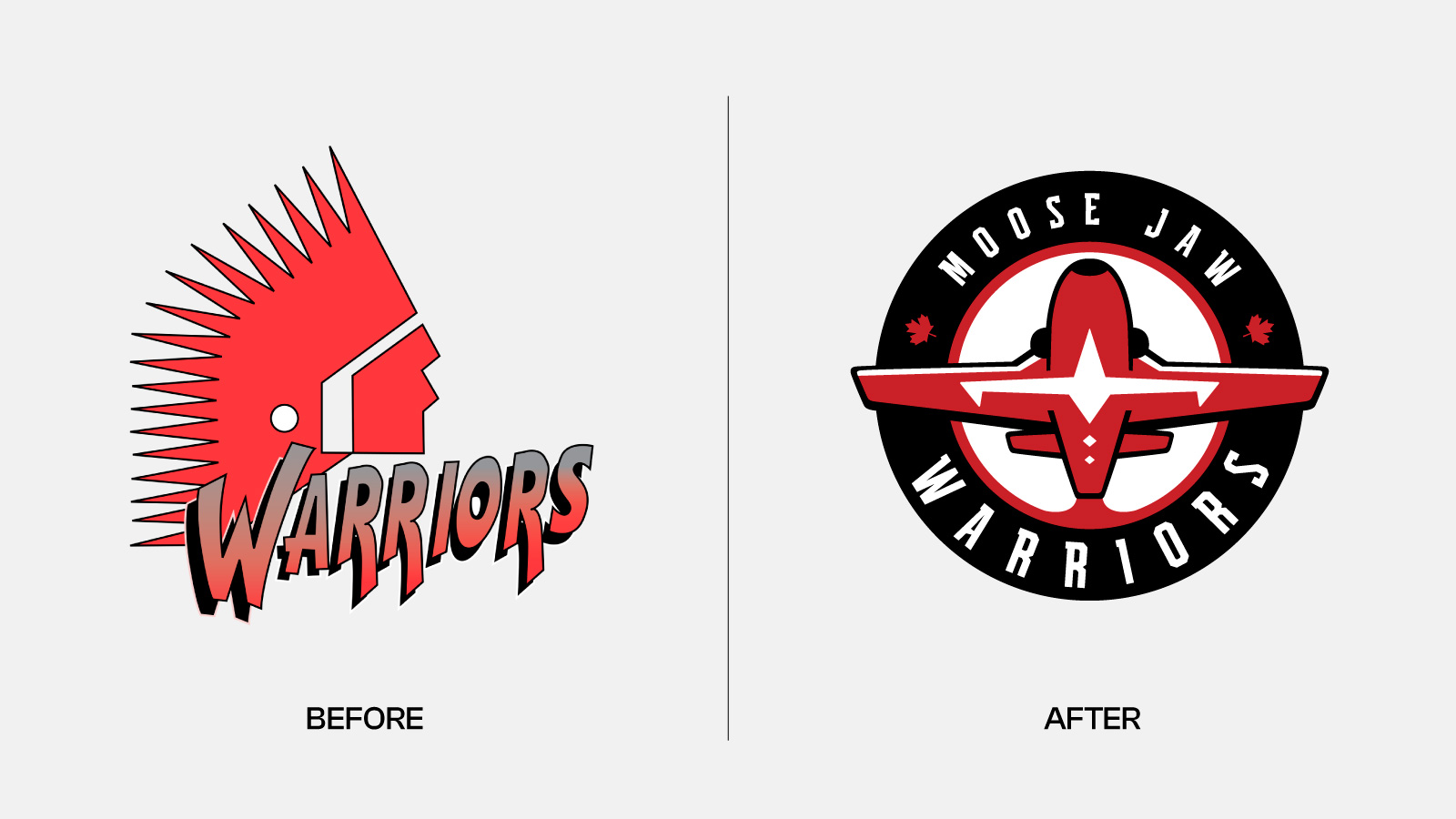
The Moose Jaw Warriors
A proud member of the Western Hockey League, the Moose Jaw Warriors released a new brand logo ahead of the 2022-23 season. The logo change comes after the Warriors announced an official review of their primary logo on October 1, 2020.
We were honoured and privileged to have worked alongside the Moose Jaw Warriors on this rebrand, creating an inclusive logo that represents Moose Jaw’s history.
A lot of thought and attention to detail went into the new logo. The design is inspired by the organization and the community’s connections with the Royal Canadian Air Force, 15 Wing Moose Jaw, and the Canadian Forces Snowbirds, 431 Air Demonstration Squadron. Over the years, the organization and the Snowbirds have built a strong relationship. In 2019, the Warriors were officially appointed as members of the Honorary Snowbird Society.
Before
After
SK Startup Institute
SK Startup Institute, formerly known as Square One, came to us with the goal of renaming and rebranding the program in the hopes that it would reach more entrepreneurs across Saskatchewan. The ‘Square One’ name and brand wasn’t having the impact that the organization had envisioned.
The new logo is simple, yet powerful. The Saskatchewan icon representing our Prairie home sits next to the wordmark. Both work on their own, but come together to create a logo that perfectly encapsulates the program.
Before
After
Hometown Homes
Custom home builder, Hometown Homes wanted a logo that represented their hometown roots. They are down-to-earth and grounded, and they wanted their colours and logo to reflect the feeling you get while working with them.
The new logo elevates their look and represents their commitment to quality. It’s warm and inviting; a brand that customers can feel at home with.
Before
After
Warrior Physio
Warrior Physio wanted their mission to be evident in their brand identity but felt that it was lacking that connection. The old logo featured a yoga pose, which didn’t apply to their business, and the overall brand wasn’t speaking to the right audience.
We opted for a logo that is clean and simple. The word Warrior stands on its own and evokes strong feelings without the need for bells and whistles. The logo is bold and in motion. The movement in the letters creates a rhythm of movement that draws your eye to the word “warrior.” It is strong but also provides a welcoming feel to potential new customers.
“Company values (also called corporate values or core values) are the set of guiding principles and fundamental beliefs that help a group of people function together as a team and work toward a common business goal. These values are often related to business relationships, customer relationships, and company growth” (Hotjar).
Most of us have defined our values, and many of us have them written in a place of prominence — whether that’s a company handbook or stenciled on the walls. But practicing them, that’s a whole ‘nother story. Here are a few tactics on how to live and practice your company values.
Tips to Practicing Your Company’s Core Values
Many companies get fired up about creating core values, only to never look at them again, or pull them out only at staff meetings. Here are some ways you can integrate your core values into your workplace.
When hiring new employees, ask them questions that will help you see if they align with your core values
For example, if one of your core values is collaboration, you might ask a question like “Describe a time your team failed to complete a project on time. What would you do differently, if you had the chance?”
Review values on a regular basis
Tie meetings to a particular value, or revisit all values each meeting.
This can be as simple as a page of your slideshow presentation listing all your values, or putting one value front and centre at the beginning of a meeting.
Put values in the physical workspace
Posters get a bad rap, but they are only ineffective when used alone.
Hang posters of your values in a prominent place in the office, or even paint your values on a wall. This serves as a constant physical reminder of all that you stand for.
Ask employees
Interaction helps with memory.
A friendly pop quiz on company values, reminders on Slack, and asking employees to share what values mean to them are ways to engage your workforce.
Share your values publicly
Sharing your values has a way of solidifying them and holding your feet to the fire.
Put your values on your website and share them on social media.
Let team members have a say in creating the values
Depending on how long you’ve been operating and how well-defined your values are, incorporating your employees into the decision making process can create buy-in.
If you already have your values defined, ask your team if they resonate. Go through each one and have lots of discussion. If you don’t have them defined, facilitate a workshop with as many employees as possible to define them.
Have values influence events
When you’re putting on a company event, let your values dictate the kind of events you create.
If one of your company values is sharing, then creating a work function where employees can share their work, a talent, or a new resource fits perfectly.
Make sure compensation matches
Values and culture can’t replace money.
If one of your core values is experience, work ethic, skill, etc, make sure you’re ready to put your wallet where your core values are.
Create reflective processes
Ensure that your processes reflect your values.
For example, if your values are transparency and communication, you might consider adopting an agile methodology and working in sprints.
Core values are at the service of your organizational purpose. They define the desired behaviour to accomplish your “why.”’ When done properly, they should affect every aspect of your business, internal and external. That means compensation, workplace dialogue, email writing, processes, strategic decisions, even technology choices.
Stating your company values is important, and living up to them is even more important. Always rescheduling meetings with your direct reports? They’ll get the message that their time isn’t valuable to you, even if you have “respect” in the company handbook. If one of your values is to take risks, but employees get a slap on the wrist when they try something new, that value isn’t going to stick. You’ll seem ambiguous at best, hypocritical at worst.
Agile is an iterative approach to project management and software development that helps teams deliver value to their customers faster and with fewer headaches. – Atlassian Agile Coach, https://www.atlassian.com/agile, retrieved June 18, 2021
For those new to the agile methodology or in need of a refresher, I will start with a general overview about what agile is, and then get into a bit of the history. After that, I’m going to tell you how agile methodology works for an agency — our favourite parts, and some issues we’ve come across.
I’m passionate about agile, and this article is a little lengthy. Feel free to skip to the parts of most interest to you:
The Agile Methodology / Method is an approach to project management often used in software development. It uses incremental, iterative work sequences that are commonly known as sprints.
Agile was formally launched in 2001, when 17 technologists drafted the Agile Manifesto. They wrote four major principles for agile project management, with the goal of developing better software:
Individuals and interactions over processes and tools
Working software over comprehensive documentation
Customer collaboration over contract negotiation
Responding to change over following a plan
Traditional Agency Framework vs Agile Methodology
A traditional agency project management approach requires less input from the client, usually only interacting at major milestones. A client presents a challenge (or sometimes their proposed solution) to the agency, agency goes and solves (or attempts to solve) the problem, and reports back with a complete solution. They track time, bill by the hour, and count minutes on the phone. This isn’t how we like to work.
At Rock & Bloom (R&B), we like to work closely with all of our clients, and have them deeply involved in the project. Building a killer brand is all about empathy and listening. Our clients are the experts in their field — it’s essential that we use their expertise to strengthen and guide the work. Aside from being essential to good work, maintaining open lines of communication is necessary for the success of the agile process, too. Our most successful projects are the ones where clients are willing to invest time into the project and the process.
Using Agile Methodology Gives a Competitive Edge
The Harvard Business Review co-authored a paper with Atlassian called “Agile Practice: The Competitive Advantage for a Digital Age.” The paper is a few years old, but the principle still stands: agile methodology can see great success when applied to non-traditional industries. Many of us at Rock & Bloom come from a tech background, and adopting an agile framework felt like a no-brainer. While I am a particularly passionate advocate, many of the other folks at R&B had already bought into the methodology.
A few competitive advantages, particularly in regards to using an agile framework within an agency structure include:
Customer needs are flexible and constantly centered
Organizations can respond to market changes faster
Deliver higher quality products and services
Company and the client / end-user are able to provide valuable feedback at inflection points
Unnecessary work and redundancy are avoided through communication
Collaborating parties both feel heard and valued
The process allows for pivots and work that needs to be done on tight timelines
Feedback is immediately incorporated into the process and the product
The exact product predicted and needed is delivered
Main Frameworks
A process for managing a project that involves constant collaboration and working in iterations, agile methodology is most known for two main styles: scrum and kanban. We pull from these frameworks to build a model that works for our agency.
Scrum
Scrum is a process framework used to manage product development and other knowledge work. Scrum […] provides a means for teams to establish a hypothesis of how they think something works, try it out, reflect on the experience, and make the appropriate adjustments (Agile Alliance).
Scrum is the most popular agile framework. It focuses on a set delivery pattern called a sprint. A sprint is a short, time-boxed period when a scrum team works to complete a set amount of work (Atlassian). Sprints typically last one to four weeks.
The Scrum framework has a set of events that include the following:
Sprint planning — where sprint priorities are identified
Daily standup meetings — daily discussion and coordination of that day’s work
Sprint retrospective meetings — a discussion at the end of a sprint about whether it was successful, and to identify improvements that can be incorporated into the next sprint
Using Scrum, increments of software can be delivered periodically, rather than waiting for large final software releases. For this reason, many tech companies have adopted this framework. Users of the software get small, incremental improvements on a regular basis rather than a bunch of new features and bug fixes once or twice a year.
This is how most software as a service, or SaaS companies operate. You’ll see it in most of your app updates, if you ever read them. The Facebook ios app release notes show an example of shipping small updates in periodic increments:
Screenshot from June 22, 2021 of the Facebook iOS changelog
Kanban
Kanban is a popular framework used to implement agile software development. It requires real-time communication of capacity and full transparency of work. Work items are represented visually on a Kanban board, allowing team members to see the state of every piece of work at any time (Atlassian).
Kanban was started by Toyota in the 1940s. Toyota industrial engineer Taiichi Ohno took inspiration from supermarkets to implement a “just-in-time” inventory system, which increased production levels, improved efficiency, and removed waste (Nave).
Agile software development teams today are able to leverage these same just-in-time principles by matching the amount of work in progress to the team’s capacity. This gives teams more flexible planning options, faster output, clearer focus, and transparency throughout the development cycle (Atlassian).
A main difference between Kanban and Scrum is that Kanban is not necessarily iterative. A Kanban process allows the software to be developed in one large development cycle.
Estimations
Within the agile methodology, there is something called estimations. Agile estimation is about evaluating the effort required to complete each work item listed in the prioritized backlog. Estimates are hard — you need to anticipate how much time / effort you are going to need to complete a given task. At Rock & Bloom, the team who will be completing the work will do the estimation. And it is just that — an estimation. Sometimes we’re off, but that’s a-ok. The point of doing estimation is to help our account managers plan out a timeline, allot work fairly, and scope projects.
In traditional agile, points are abstract and arbitrary, as long as everyone agrees. At Rock & Bloom, we loosely associate points with hours / days to have a reference point.
How it works at Rock & Bloom is that we each estimate tasks in our backlog prior to or during our weekly sprint planning meeting. We use this system:
1 point – some small amount of time
2 points – less than half a day
3 points – about half a day
5 points – roughly a full day of work
8 points – more than a 5
13 points – even more than an 8
We try to never have anything larger than a five. Estimating something correctly is hard. And as tasks get more complex, they get more daunting to work on, harder to review, and harder to estimate correctly. If something is bigger than a five, we will break it up into sub tasks and estimate those instead.
Why no four, you ask? No 10? We use the fibonacci sequence — computer scientists ❤️ the fibonacci sequence. Using these numbers prevents any estimations from being too close to one another, which can make estimating harder. Think of it in terms of weight — it is easier to tell the difference between a 5lb weight and a 8lb weight, than 5lb and 6lb weight. Fibonacci numbers also don’t double (with the exception of 1 to 2), which also makes the sequence very well suited to estimating. When numbers double, we tend to think too much about if one task is “twice as hard” as another task, which is not helpful.
During sprint planning, each team agrees on the set of work they will complete during the sprint based on the total of the estimates. The work we choose is pulled from a prioritized backlog of tasks. We use Monday.com to track our points, tasks, and status.
Agile Methodology at Rock & Bloom
All four principles are important, but here at Rock & Bloom, the last two points really resonate with us:
Customer collaboration over contract negotiation
We let this principle guide us through all kinds of projects. It means that we work closely with our clients and get feedback from them at multiple points in the process. We are able to assess that information and implement it, instead of being stuck in what was decided on day one.
Responding to change over following a plan
Often as a client moves through our processes, they start to more thoroughly understand their own problem and needs, and we are able to respond to that. We don’t stay locked into any early decisions, and we are able to pivot as necessary.
Agile methodologies were built for teams of software developers. Since we are not all developers and we are not working on software, strictly following Scrum doesn’t work for our teams. We have cherry picked the things we like from both Kanban and Scrum, and are using those to run a sort of modified scrumban, which we usually just call Our Process.
Some of Our Favourite Things About Our Process / Agile Methodology
We love the agile framework, and it has allowed us to create amazing work while giving employees freedom and flexibility. Here are a few our favourite things about applying an agile framework to an agency model:
Self organizing teams
This is a team that does not depend on, or wait for, a manager to assign work. Instead, these teams find their own work and manage the associated responsibilities and timelines.
All of our teams are different degrees of self-organizing
Our account managers set priority for all of the tasks for the week, and then we are able to start work on the next highest priority thing that we have the skill set to complete.
Work-in-Progress (WIP)
This term comes from the Kanban framework. It limits work that is currently being done. This means that if the WIP limit is one, each team member can only have one task in progress. Applying these limits forces the team to focus on a limited number of tasks and drive work to completion.
Note that some team members abide by this rule better than others…
Ownership of the work
Once a team member has selected a task to work on, they are the owner of that task, and it is their responsibility to get the task completed!
Constant communication and collaboration
We trust everyone to get their work done, in their time. For some people, this means regular work hours, whereas for others (ahem, Nhi), it might mean coding into the wee hours.
At any time in the sprint account managers and other team members can see the status of a task just by glancing at the task board.
Daily check-ins give everyone a lot of opportunity to make sure they are going down the right track with their task, and ask for help if needed. While each team member is responsible for their tasks, we are still a team working collectively towards the same goal.
Adapting Scrumban to an Agency Model
Since the start of R&B, we have tried many different ways to implement a strong agile process. This started initially with having a fully physical board with post-it notes or actual paper index cards that we would physically move around on our task board every day. As we grew and added some remote team members, we moved our task board to a digital format. We started with a simple and free option, Trello.com, and as we felt the need for more functionality, we moved to Monday.com.
Monday.com has allowed us to collaborate with many people on the same board, and effectively keep track of what we are working on. It also allows us to easily predict what a team can complete in a week, which can be used for forecasting when something will be finished or how long it will take for us to get started on a new client request based on the amount of work we currently have in the queue. It has a predictive element for account managers, who can see at a glance when new work can be started and completed.
We sprint from week to week, so every week we take a look at our last week’s work and have a sprint retrospective meeting. This is where we look at the positives and negatives, questions, and going forwards from the week. When R&B had only five people, we did this weekly with the whole company, and took a look at things at a more general level. Now that we have grown and have more specialized teams, we have started to do this per department, which allows us to get more technical and specific in the feedback we give our teams. Design and content, development, and strategy teams each have their own retro and sprint planning meetings.
Our Rituals
We still meet as a company once a month in an R&B share session, where we share company news, timeline updates, and demo a project we have in progress. This lets everyone in the company stay connected without adding a lot of extra meetings to our calendars.
Sharing is one of our core values, and as we grow bigger, we’re finding that many projects don’t touch every single person in the company. Our share sessions are a great way to stay up-to-date on the cool things that our coworkers are working on, see new tech in practice, and hang out with our work fam.
When Rock & Bloom started we had only one person in each different department — development, design, accounts, and content. We were one big team working together on every single project. This made it hard to use traditional scrum because not every person working on the project could pick up every single task. For example, a designer could not pick up a coding card, likewise a developer cannot pick up a design card. It was also difficult to estimate how long a task would take, since “designing a homepage” and “developing a homepage” really aren’t very comparable. We have found our agile process works best when we can break down tasks to a very similar “size,” and this was difficult with the cross functional nature of our teams and the make up of our work.
As we grew, we made the choice to adjust the teams to be skillset based, with the developers forming one team, the designers, content writers, and videographers forming another, and strategy a third. This lets our points per team become more consistent and our work capacity for a sprint more predictable.
Adapting the agile methodology to best suit the needs of agency life has been a huge part of our success. We are thankful for the amazing frameworks that Scrum and Kanban give us to build on. We will continue to adjust our process as we grow and change, and we continually revisit the basics to stay true to our values.
Our job is making you look good, and making it look easy!
We always start from the top.
We approach every enterprise from the top, starting with the high level strategy and goals, working our way down to the delicate details. With clearly defined objectives, each piece of your collateral becomes a step toward conquering your goals, chock full of your brand identity. Our approach is empowering, giving our clients the tools they need to be successful and marketing goods that wow their customers. We like to be involved in projects from the spark of an idea through to fruition and reporting, so we can define your expectations and then cover them in dust.
We deliver value, not hours.
We charge by the project, never the hour. Don’t sweat it if you want some changes, an update, a phone call, a conversation—we’re on your team now.
Design is built in.
Design isn’t separate from what we do—it’s everything we do. Heck, it may just be who we are. Good design isn’t the lemon wedge in the drink or the hero image on your homepage. Good design is so fully integrated with your brand and your objectives that it becomes each project.
We are a team of the best.
We’re greater than the sum of our parts, but our parts are pretty wonderful, too. We’ve carefully curated a team that’s full of unique and incredible talent. Each person is a subject matter expert in an area that is essential to creating remarkable brand strategy, whether that’s design, web projects, video, development, marketing, content or project management. There are no middle wo/men at Rock & Bloom—every team member working on your project brings momentous value.
Data driven work.
Usually we deliver what you want, and always we deliver what you need. Through our trusted processes of intense research, creative facilitation and digging deep into objectives, we uncover the problem that needs to be solved and tackle it with tenacity and ferocity.
Your success = our success.
We like to play in the mud, get our hands dirty. We want to learn about your business, your goals and your strategies and then build something that drives the results you need. You’re the expert in your business, we’re the expert in ours—collaboration is crucial to the success of your project. When we see your product flying off the shelves, your door swinging, your phone ringing and your bottom line growing, we’re truly happy. There is no greater joy and no metric better to measure than seeing our work manifest itself as your success.
We’re fun.
When we left a meeting at Palliser, Scott Byers said “This is why I love working with Rock & Bloom, every meeting makes me happy and leaves me with more energy!” That made us shine. It’s what we strive for and something we hear all the time, and we never tire of the repetition. Our energy, optimism and grit make working with us fun, exciting and productive.